Small Account, Big Reach: What We Learned About Instagram Marketing
We organised out third workshop, this time on Online Marketing for Instagram.
Likes don't matter as much as you think. Algorithms reward consistency over perfection. And small accounts have a natural advantage that most organisations are completely wasting. These were just some of the insights from our latest ESN UWB Pilsen workshop, led by Milos Zlesa, Head of Social Media, Ant.
Social media can feel like a black box. You post, you wait, nothing happens — or something goes viral for no obvious reason. This workshop was designed to open that box: to explain how Instagram actually works, what the algorithm really measures, and what small organisations like ESN can do to make their content travel further.
Good News First: Small Accounts Win
The session opened with a statistic that surprised many in the room: smaller Instagram accounts consistently outperform large ones on the metrics that matter. Accounts like ESN UWB Pilsen can expect around 4.8% engagement rate, 35% higher reach in Stories, and a 20% view rate on Reels. The reason is simple — authenticity. And that is something student organisations have in abundance.
What the Algorithm Actually Measures
According to Adam Mosseri, Head of Instagram, the platform tracks three signals above all else: watch time, likes per reach, and sends per reach. Likes are the weakest signal of the three. What matters far more is whether people watch your content to the end — and whether they send it to someone else.
The workshop also introduced skip rate as a critical metric — one that Instagram itself ranks first in its own analytics. A low skip rate tells the algorithm your hook is working. A high share rate tells it your content is worth spreading. Likes, in comparison, barely move the needle.
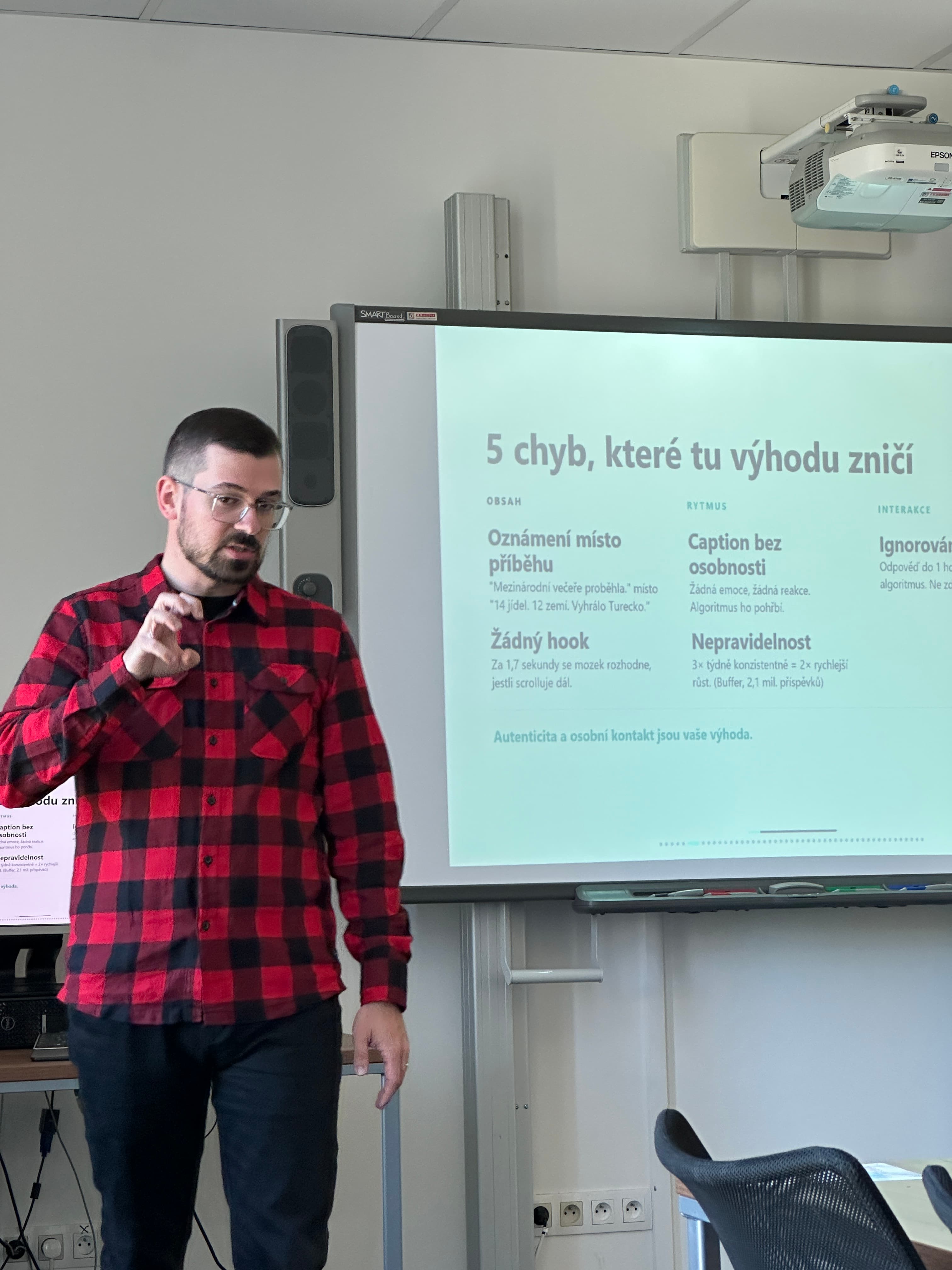
The 5 Mistakes That Kill Your Reach
Milos walked the group through the five most common content mistakes he sees organisations make:
• Announcements instead of stories — posting "International dinner took place" instead of "14 dishes. 12 countries. Turkey won."
• No hook in the first 3 seconds — the brain decides whether to scroll within 1.7 seconds. No movement or contrast means no attention.
• Captions without personality — no emotion, no reaction, no reach.
• Inconsistency — posting 3 times a week consistently produces 2x faster growth than sporadic bursts (Buffer, 2.1M posts studied).
• Ignoring comments — replying within 1 hour of posting is a strong positive signal to the algorithm. It is not just politeness.
The HCS Framework: A Formula for Every Post
The most practical tool from the workshop was the HCS framework, which applies to every format and every post:
• H = Hook. The first sentence stops the scroll. "14 dishes. 12 countries. Turkey won." Not an introduction. Not a logo. A reason to stay.
• C = Content. What actually happened — told as a story, not a statistic. Show the Portuguese student trying svickova for the first time. His face tells the whole story.
• S = Share trigger. Something that makes the viewer want to send it to someone. Emotion, surprise, nostalgia. "Send this to someone who was on Erasmus."
How Often and How Long
The workshop closed with clear, data-backed guidance on posting frequency and Reel length. For frequency: 3 to 5 feed posts per week (Reels and Carousels), 1 to 2 Stories per day. Posting every day or only once a week both hurt reach. For Reels: under 30 seconds for quick moments and hooks (completion rate must exceed 80%), 60 to 90 seconds for stories and tutorials. And regardless of length — 50% of viewers watch without sound, making subtitles non-negotiable.
The key takeaway: consistency beats production quality. Authentic moments without preparation outperform polished graphics every time — as long as the first three seconds give people a reason to stay.
This event was realised with the support of the Grant for Student Activity Support (GRAS) of the University of West Bohemia in Pilsen